

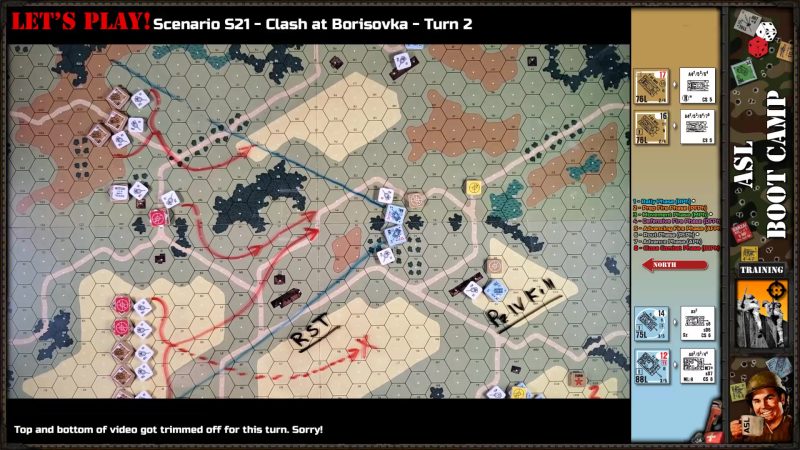
Today, we have a special guest in the palatial and stately Academy studios, none other than Jim Bishop, here to spread his ASL knowledge about AFV combat. To illustrate his points, we’ll revisit Turn 2 of Clash at Borisovka, a Starter Kit scenario I recently played as part of my “Let’s Play” series, which demonstrates the basic mechanics of vehicle movement and combat.
This is a long one, a little over 1.5 hours, but Jim provides some valuable insights about the tactics and numbers involved with armor combat in ASL. For those who’d rather read than watch, below is the contents of the video transcribed into article form.
Sitrep
In this article, we explore Turn 2 of Clash at Borisovka (S21) in detail, unpacking the armored tactics available to both Russian and German players. With contributions from veteran ASL tactician Jim Bishop, the discussion dives deeply into odds manipulation, movement tactics, firepower calculations, and AFV coordination…all from the dual lenses of historical insight and mathematical optimization.
Odds Over Ordnance
To begin, it’s important to understand that ASL, even in its Starter Kit form, is not a game of brute weapon superiority. Rather, it is a game of managing odds. Most attacks in ASL consists of a two-part process: hitting the target and affecting it. Each part is probabilistic. The game system provides tables and modifiers, but mastery lies in shaping the conditions of the fight to your advantage.
 This is particularly true in tank engagements, where the difference between survival and destruction often hinges on a few percentage points. Dice cannot be controlled, but conditions can be engineered. And in ASL, controlling conditions is how good players win.
Jim Bishop calls this “tipping the odds.” Think of each to-hit and to-kill sequence as a math problem: multiply the chance to hit by the chance to kill and get your total odds of affecting the enemy vehicle. Then adjust the situation through motion, covered arc changes, armor facing, and range, to skew that percentage in your advantage. You don’t need to win every engagement. You need to create enough favorable ones that the averages work for you over the course of the game.
In that sense, ASL becomes a game of opportunity engineering.
The First Best Shot
One of the most referenced articles in ASL tactical literature is Bruce Bakken’s piece on AFV strategy (“Panzer Gegen Panzer,” ASL Annual ’93a), wherein he introduces the concept of the “first best shot.” His argument is that the defender, by nature, has the edge. They are stationary, they get the first real chance to fire, and with proper positioning, they force the attacker to take sub-optimal paths into danger.
 For a defending German player in Clash at Borisovka, this principle holds true. The goal is to wait in ambush, minimize exposure, and take that high-odds, high-effectiveness first shot that either destroys or decisively disables a Russian tank. The Panzer IVs and Tigers can fire Crew Exposed (CE), improving their to-hit numbers. The Russians, with slow-rotating turrets and the requirement to be buttoned up (RST turrets), already start behind.
For the attacker, the situation is more complex. The Russian player must strive not just to shoot first, but to maneuver until their shot is statistically better than the defender’s. This is the concept of the “first best shot” reimagined: the attacker’s role is not to fire first, but to create the best possible shot available in the flow of battle, even if it comes second.
That means movement. That means flanking. That means using speed, angles, and firepower in sequence to overwhelm the defender’s initial advantage.
Russian T-34s vs. German Armor
To understand how this plays out in Turn 2 of Clash at Borisovka, we need to look at the matchups on paper.
 The Russia T-34/76 models (M41 and M43) come armed with the 76L gun, a solid weapon that performs best at close range due to Russian capability. Its standard AP round has a base to-kill number of 13. Against the frontal armor of a Panzer IV (which is a 6), the Russian player needs to roll a 7 or less to kill.
However, per ASL’s vehicle damage system, a roll equal to the threshold only results in a Shock or Immobilization, not a kill. That means actual elimination happens only on a 6 or lower…roughly a 41.7% chance after a hit is confirmed.
Let’s now calculate the overall effectiveness. Assuming a to-hit number of 8 (which is common at mid-range for a buttoned Russian tank), the probability of hitting is about 72.2%. Multiply this by the 41.7% kill probability, and you get a total probability of around 30.1%.
 Now compare this to the German 75L gun on the Panzer IV or the 88L on the Tiger. If a Tiger gets APCR (Armor-Piercing Composite Rigid), the to-kill value jumps to 23. The T-34’s frontal armor is an 11. A 23-11 differential means nearly every hit results in a kill or at least a Shock, depending on turret vs. hull hits. The odds of survival plummet—unless the Tiger misses. So once again, the attacker’s focus becomes preventing hits in the first place.
This reinforces a central idea: Russian armor cannot trade hits with Tigers. They must manipulate odds, movement, hindrances, limited line of sight (LOS), and side/rear attacks to survive and fight back.
Movement as a Weapon
One of the great balancing elements in Clash at Borisovka is the difference in mobility.
 T-34s often have 16 or 17 Movement Points. This is an enormous tactical resource. With careful planning, the Russian player can use this mobility to close the distance, flank German armor, or retreat out of LOS when needed. Moreover, the geometry of ASL hexes means that the closer you are to a stationary vehicle, the fewer hexes of LOS you expose yourself to as you move.
Based on an AFV’s CA “cone,” at 10 hexes away, a vehicle is in your LOS for 5–6 hexes of movement. At 2 hexes away, it’s only in LOS for 1 or 2. The closer you are, the safer your approach, paradoxically.
This is particularly relevant when dealing with covered arcs. If you approach from a flank, and enter the defender’s LOS for just one or two hexes, you can often evade response fire altogether…or force the defender to change their covered arc, costing them shot efficiency.
Jim explains that the Russian player should use this mobility to get within six hexes whenever possible. That’s the range where Russian to-hit numbers are most favorable, and their kill potential doesn’t fall off due to range modifiers.
The Germans, in contrast, benefit from maintaining long-range dominance. They should place their Tigers centrally and the Panzer IVs further back, ensuring maximum field of fire and minimal exposure.
Intensive Fire: A Risk Worth Taking
 A major shift in tactical outcome in Turn 2 comes from the decision to use Intensive Fire. Many players avoid it, fearing Main Armament (MA) malfunctions. But statistically, it’s often the right call, particularly in a scenario like Clash at Borisovka, where even a malfunctioning T34 can still exit and score victory points.
The chance of MA breakdown via Intensive Fire is about 16.7%. But the chance of hitting and killing a target (especially with acquisition and ROF bonuses) is often 25% to 40% or higher.
More importantly, a malfunctioned gun doesn’t necessarily mean a useless tank. The vehicle still counts for exit points. It can still absorb fire. It can cause diversions. It can still maneuver. In many cases, it’s better to push the odds and force a resolution rather than play conservatively and lose to attrition.
In Turn 2, by aggressively using Intensive Fire, the Russians can shock, immobilize, or even destroy one or more German tanks. That can swing the momentum and change the scenario’s fundamental win calculus.
Defensive Fluidity
Another layer of armored tactics in ASL (often misunderstood or underused) is Motion Status and Covered Arc (CA) changes.
When a tank declares motion, it can shift its covered arc for free. This becomes a powerful tool in defense, especially when under threat from multiple angles. Jim Bishop refers to this technique as a “motion escape.” It involves parking vehicles in such a way that, when threatened, they can pivot and move into bypass or blocked LOS terrain, reducing exposure.
In full ASL, bypass adds further richness to this concept. But even in Starter Kit, using terrain, building placement, and narrow arcs to funnel enemy approach is vital.
This ties into another concept known as the Dance of Death: the process by which a defender uses sequential weapon systems (main gun, coax, bow MG, even Intensive Fire) to fire in different directions…each allowing a covered arc shift. A skillful player can rotate through targets, adjusting arc with each shot, and always keep the strongest armor facing the threat.
But there’s a caveat: vehicles left in Motion at the end of their turn are dangerously exposed. Bounding fire penalties, doubled lower die rolls, and inability to gain acquisition make them easy prey. Motion should be a transition…not a destination.

Victory Conditions
The scenario victory conditions dictate that the Russians win by exiting more vehicles than they lose…or by eliminating more enemy AFVs.
The Russians begin with 10 tanks. Three must exit to win. That leaves seven available to engage the enemy. The Germans begin with six tanks. Thus, if the Russians destroy all six German AFVs and only lose five, they win. The math is tight, but manageable.
This directly influences tactical decisions. For example, a Russian tank with a malfunctioned MA still counts as an exited vehicle if it drives off the board. Therefore, such a tank should not waste time on repair attempts. Instead, it should be redirected immediately toward exit conditions, preserving its VP value. The Russians should not attempt to repair malfunctioned MA in Clash at Borisovka.
Conversely, the German player’s only reliable win path is through destruction: kill at least eight Russian tanks. It doesn’t matter if every German AFV is lost in the process. If eight Russian tanks are destroyed, the Germans win.
That clarity sharpens each engagement. Every shot matters. Every loss matters more.
Numbers Beat Quality
Once a single German tank is destroyed, the Russians gain initiative. With mobility, numerical superiority, and close-range effectiveness, they can swarm isolated German AFVs. Even the mighty Tiger cannot face multiple threats from different arcs.
Tactical swarming involves using movement to encircle a German tank, presenting side and rear shots while staying out of their CA. Done correctly, this removes their ability to dance or respond.
Swarming works best when executed with coordination. Ideally, two or three tanks converge on one target, forcing split decisions, arc changes, and exposure. The defender is reduced from a predator to a cornered target.
This is where the game turns. If the Russians can get one tank up (kill one German tank without an equivalent loss) they can force the Germans to attack, and then destroy them piecemeal with layered fields of fire.
Tactical Takeaways
At the end of Turn 2, the Russians may find themselves up a tank, with one or two German AFVs shocked, immobilized, or eliminated. If so, the strategy shifts: from attack to containment. The goal becomes forcing German movement—something their vehicles, particularly the Tigers, are not well suited to do alone.
Key takeaways include:
- Russians should use Intensive Fire early when odds are favorable, especially if exiting a broken tank is still useful.
- Close the range whenever possible. The Russian gun performance falls off steeply beyond 12 hexes.
- Use Motion carefully, as a means of escape, not as a default status.
- Swarm and isolate. Tigers are deadly, but not omnipotent.
- Don’t waste broken guns. Exit them and make the Germans chase.
- Victory is math. The Germans need 8 kills. Deny them that.
Debriefing
Clash at Borisovka is more than a balanced Starter Kit scenario; it’s a microcosm of Eastern Front armored warfare: speed vs. strength, numbers vs. quality, offense vs. defense.
What Jim Bishop’s analysis reveals is that ASL armor combat, even in its streamlined Starter Kit form, rewards deep tactical thinking. It rewards planning, not luck. Success lies not in having the best tanks, but in creating the best opportunities…shaping engagements where your odds are better than your opponent’s.
GET TO THE CHOPPA…!!! 
Article © 2025-2026, N. Ulen & J. Bishop. All Rights Reserved. Copyright & Fair Use Notice.
ASL-Players.net is not affiliated with Hasbro, AH Games, Inc., or MMP, Inc.
Advanced Squad Leader is a trademark of AH Games, Inc.
These Articles Might Interest You
 ASL Boot Camp #36: Let’s Play Clash at Borisovka (Turn 1)
 ASL Boot Camp #37: Let’s Play Clash at Borisovka (Turn 2)
 ASL Boot Camp #38: Let’s Play Clash at Borisovka (Turn 3)
 ASL Boot Camp #39: Let’s Play Clash at Borisovka (Turn 4, End)
 ASL Tactical #1 – Motion Status Attempts
 ASL Boot Camp #13: The Guards Counterattack (Turn 1)
 ASL Boot Camp #14: The Guards Counterattack (Turn 2)
 ASL Boot Camp #15: The Guards Counterattack (Turn 3)
