
Below is a (work in progress) list of acronyms and terms used in the Advanced Squad Leader system, along with their short descriptions. This isn’t by any means a complete and exhaustive list and may not include “non-official” acronyms commonly used by players and/or third-party publishers. Definitions of these acronyms will show up across the entire site if they are used in an article. Simply hover over the highlighted acronym and it will display on your screen.
Anti-Tank
The catch-all prefix for anything meant to stop armor. An A-T Gun is a towed piece firing armor piercing rounds over open sights, and an A-T mine attacks vehicles rather than the men walking past it. Terrain matters to the distinction: A-T mines that end up in shallow ocean become anti-boat mines, and anti-boat mines on a beach become A-T.
Anti-Aircraft Machine Gun (D1.83)
A machine gun mounted for anti-aircraft use. Its FP fires inside or outside the vehicle's current turret or hull covered arc at no penalty, so it counts as neither turret-mounted nor bow-mounted. An AFV's AAMG only works if the crew is Crew Exposed, so a buttoned-up AFV can't use it, though a Hero still can. Normal Range is eight hexes.

A Bridge Too Far (chapter R)
Arnhem, and the 2nd Parachute Battalion's grim September 1944 around the main road bridge. The chapter brings the bridge itself, the Ramp, factories, cellars and the Blockhouse. Up to four scenarios run per day, and CG Victory isn't settled until the whole campaign ends, unless somebody takes it early by Sudden Death.
Armored Car (D1.12)
A wheeled armored vehicle, recognizable by the white circle behind the MP number on its counter. That circle represents a wheel and sets the vehicle's movement type. Armored Cars are usually fast and lightly armed, and because they're wheeled rather than tracked they're limited in the terrain they can enter.

Arrow Cross Militia (FB13.9)
Hungary's fascist party militia, fighting for Budapest after the Germans installed the Arrow Cross in October 1944. Their counters carry the party symbol in the top right corner. The 5-2-6 squads and 2-2-6 half-squads count as 1st Line, but their underscored Morale Level matters for Replacement, they can't be Disrupted, they take a -1 on every PAATC, and they may Massacre as if they were SS.
Adjacent (A.8)
Two hexes are adjacent if they share a hexside. Two Locations are ADJACENT, in capitals, only if a LOS runs between them and you could walk a hypothetical squad from one to the other in the Advance Phase, ignoring any enemy in the way. The capitals are the tell: they mean the stricter test, not the simple one.
Advance (A4.7)
The Advance Phase move. Infantry that isn't broken, pinned, TI or locked in Close Combat can shift one hex, or change level inside its own hex, but never both in the same phase. It can advance into a hex the enemy holds, which is how Close Combat starts. Nothing shoots at it while it does, which is what makes the phase worth saving for.
Assault Engineer (V VotG24, O RF19)
Demolition troops, and you spot them by the Demolition Charge printed on the counter. Russian 6-2-8s and German 8-3-8s, with their half-squads, are Elite Class, count as Sappers, and add one to their Close Combat Value. The extra SMOKE ability engineers normally get is already baked into the printed exponent and can't be raised again.
Armor Factor (D1.6)
The rating of an AFV's armor protection, printed as two numbers beneath the MP number on its counter. Each AFV carries four of them: front hull, front turret, side/rear hull and side/rear turret. Eleven values exist in the game, running 0, 1, 2, 3, 4, 6, 8, 11, 14, 18 and 26. An unarmored vehicle shows a « symbol there instead.

Advancing Fire Phase (A3.5)
The fifth of the eight phases in a player turn. The ATTACKER's units that didn't fire in the Prep Fire Phase, and didn't try anything needing TI status, can fire here at half FP. Flamethrowers, Molotovs, Demolition Charges and Opportunity Firers attack at full strength. Every Prep Fire and Bounding Fire counter comes off at the end of the phase.

Armored Fighting Vehicle (D1.2)
Any vehicle that has an armor factor. Note that 0 is a valid armor factor; an unarmored vehicle carries a symbol in place of those numbers and doesn't qualify. The advantage is that an AFV can't be harmed by Small Arms on the IFT unless it's hit through an unarmored Target Facing, though its passengers and riders may still be Vulnerable.

Assault Gun
A gun carried on a tank chassis in a fixed casemate instead of a turret. In ASL that makes it Non-Turreted (D1.33), so there's no turret covered arc to change and the whole vehicle has to turn to bring the gun to bear. The trade is a bigger gun on a lower, cheaper hull than a turreted tank could carry.

Australian and New Zealand Army Corps (A25.44)
Australian and New Zealand troops. ASL handles them under the British nationality rules, with one distinction of their own: Good Order ANZAC forces are Stealthy unless they're Green. That status is inherent to the troops rather than something a scenario has to hand out, so it travels with them wherever they turn up.

Armor Piercing
The default ammunition when ordnance fires at an armored target: solid shot meant to punch through armor rather than burst. Hits are resolved on the AP To Kill Table. Against infantry it's mostly wasted, since a shot that passes clean through does far less than a bursting HE round would. An overscored Caliber Size means the weapon can't fire it at all.
Armored Personnel Carrier
A vehicle meant to carry infantry forward rather than fight for them. Most British APC are carriers, and the Indian Pattern Carrier Mk IIA shown here is one of the odder ones: it's wheeled, not tracked, built in India on Canadian Ford running gear with locally made armor plate. It did the Universal Carrier's jobs, hauling an LMG or anti-tank rifle crew.

Armor Piercing Composite Rigid (C8.11)
Special ammunition built around a tungsten core inside a light alloy body. Ordinary steel AP shot tended to shatter at the velocities needed against thick armor, and a solid tungsten round was too heavy for the breech to handle. The composite solved both problems. It's shown as A# on the counter, and availability depends on the scenario's date.
Armor Piercing Discarding Sabot (C8.11)
A refinement of APCR that shares the same rule. The tungsten core again sits inside a light alloy body, but here the sheath falls away once the round leaves the muzzle, so the lighter core flies on faster and hits harder. It's shown as D# on the counter, and like APCR its availability depends on the scenario's date.
Advance Phase (A4.7)
The seventh of the eight phases in a player turn. Infantry that isn't broken, pinned, TI or marked with a CC counter may advance one hex, or change level within the same hex, but not both. A unit can manage both at once only by advancing into an adjacent hex that sits at a different elevation, such as a hill or a Depression.
Artillery Request (C1.3)
The opening step of an Offboard Artillery mission. With Radio Contact established and Battery Access in hand, the player puts an AR counter on a hex holding a Location his Observer can see. LOS is then checked; if there isn't one to any non-Aerial Location in that hex the AR comes off, the Observer is done for the phase, and the opponent can cancel the Fire Mission.

Artillery (C2.2)
Ordnance that specializes in throwing high explosive, represented by a 5/8" counter. It's one of the six non-vehicular Gun categories in ASL. The Caliber Size printed on the counter tells you what it can fire: overscored means it can't fire AP, underscored means it can't fire HE, and a plain number means it can fire both.

As Soon As Possible (G14.234)
Shorthand for when Passengers, Riders or Crew are forced out of a vehicle. They can leave at any point during the current or the next friendly Movement Phase, but they have to be out before that phase ends, whichever comes first. If they're broken at the start of a Rout Phase, they get out in that phase instead.
ASL Rulebook
Shorthand for the Advanced Squad Leader Rulebook, because saying the whole thing out loud gets old fast. It's the binder every ASL rule lives in, divided into chapters A through H plus W for the Korean War. Chapter A opens with the Index and Glossary, which is where you look up any term or abbreviation you don't recognize.

Advanced Sequence of Play
A fold-out divider that walks through every phase of a turn in order, listing what each player does and exactly when. It's far more detailed than the short sequence printed in Chapter A, and it's the fastest way to settle an argument about whether something can still be done in the phase you're in.
Anti-Tank Gun (C2.2)
A Gun built to kill vehicles, firing armor piercing shot on a flat trajectory. It's one of the six non-vehicular Gun categories, and the Caliber Size on its counter shows which ammunition it can use. Guns are awkward to move once they're sited, so where you set one up usually decides how much work it does.

Anti-Tank Magnetic Mine (C13.7)
A hand-placed magnetic charge that never gets a counter of its own. Any German Infantry unit from 1944 on is treated as possibly carrying one. An unbroken, unpinned German unit attacking a vehicle in Close Combat can declare an ATMM attack before resolving it: on a Check dr of 1-3 a man gets it placed, which adds a -3 DRM to that attack.

Anti-Tank Rifle (C13.2)
A Support Weapon rifle firing armor piercing rounds, resolved on the C3 To Hit Table and the AP To Kill Table. Any unbroken Infantry unit can use one, though doing so counts as using a SW. Maximum range is 12 hexes. It was outclassed by 1943, and it's really only a threat to light armor by then.

Armored Vehicle, Royal Engineers
A Churchill rebuilt by the British as an engineering tank. It keeps an Inherent Driver even after its crew bails with the Demolition Charges, and it carries a short, fat Petard mortar instead of a gun. That weapon hits on a Basic To Hit Number of twelve, dropping two for every hex of range, so it's devastating up close and useless at distance.

Bazooka (C13.4)
The American rocket launcher, and a Support Weapon any unbroken Infantry MMC can fire. Counters come in three versions, BAZ 43, 44 and 45, and American units always use the latest one available. Each has its own abbreviated To Hit Table printed on the back of the counter, used against armored and unarmored targets alike. Only the BAZ 45 can fire WP.

Bow Flamethrower (D3.6)
A flamethrower mounted in a vehicle's hull instead of its turret, so it fires only through the vehicle's Covered Arc. The counter prints the mounting prefix, firepower and X# in red, as on the BF30 carried by both Shermans shown here. Vehicular flamethrowers often have more firepower, more range and a different X# than the infantry kind, but otherwise they work the same way.

Bounding First Fire (D3.3)
Vehicles can't use Opportunity Fire, but unlike Infantry they can move and shoot in the same Movement Phase. Any vehicle that fires during its MPh is using Bounding First Fire, and it takes a Bounding Fire counter. Vehicular ordnance has to use one of the Case C To Hit DRM, and most non-ordnance weapons fire at half FP.

Battle Hardening (A15.3)
A Final Heat of Battle DR of 5 to 8 hardens an armed Personnel unit, even a broken one. Exchange it for an unbroken, unpinned unit of the same size one quality class higher, the way the German 4-6-7 here becomes a 4-6-8. No Strength Factor number may drop. Leaders go up a grade, an already elite unit turns Fanatic instead, and the whole thing can be refused.

Battalion Landing Team (T CG2.1)
A Marine infantry battalion plus everything attached to it, and the unit of organization the whole Tarawa campaign runs on. Each BLT gets assigned to one Entry Area before setup, and every unit in it has to come ashore there. Only one BLT lands per Entry Area per CG Date, and units can't transfer between BLTs except for a short list of specialists.

Bow Machine Gun (D1.81)
A machine gun mounted in a vehicle's hull rather than its turret, so it can fire only through the Vehicle Covered Arc. Its Normal Range is eight hexes. A BMG factor printed over a white dot is a Fixed Mount, which takes a +1 DRM against a moving target. Counters prefix a bow-mounted weapon with B, as on the Grant's B11 and B75.

Basic Point Value (H1.1)
What one piece costs to buy in a Design Your Own scenario. Players agree on a total BPV allotment, then spend it in a fixed order: Infantry first, then ordnance, vehicles, OBA and Fortifications. Every vehicle and Gun listing in Chapter H prints a BPV beside its Rarity Factor, and Infantry BPV feeds the Modified Point Value on the DYO Roster.
BLOOD REEF: TARAWA
A historical ASL module published by MMP. Details the bloody landing and invasion of Tarawa by the USMC during the PTO campaign.

Baltic Theater of Operations
Shorthand for the war's northern end, the fighting in and around Finland, Sweden and Norway. It sits alongside ETO, PTO and DTO as theater shorthand, and it covers ground the other three never do: the Winter War and the Continuation War, ski troops, deep snow and long dark days. Not to be confused with the 70s rock band Bachman-Turner Overdrive.

Buttoned Up (D5.2)
An Inherent AFV crew is either Crew Exposed or Buttoned Up, and a closed-top tank with no CE counter on it counts as BU. Buttoned up, the crew generally isn't Vulnerable to Collateral attacks. The cost is a +1 on the To Hit DR whenever the main or secondary armament fires as ordnance, and the half MP road movement rate is doubled.

Beyond Valor (ASL Module 1)
The first and most important ASL module, pairing with the ASLRB to form the core of the system. It carries the German and Russian orders of battle from 1939 to 1945, three Finnish squad types, and the markers and fortifications every later module assumes are already in your box. Ten Starter Kit-style boards and 24 scenarios round it out.

Buda Volunteer Regiment (FB14.1)
The Budai Onkentes Ezred, made up of Royal Hungarian Army men who either defected or were taken prisoner and then turned around to fight their own capital's garrison. In game terms the switch is total: BVR units are treated as Russian for every purpose unless a rule says otherwise, so they take Russian nationality rules rather than Hungarian ones.

Covered Arc (C3.2)
A vehicle or Gun's facing, and the field of fire that comes with it. Infantry and Support Weapons shoot in any direction no matter how they sit, but a Gun or vehicle counter's placement matters: the depicted barrel or vehicle front points at a hexspine, and that sets the arc it covers.

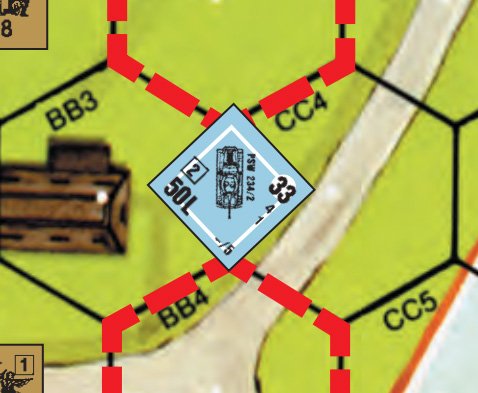
COVERED ARC FOCAL POINT (D2.32)
The vertex of the meeting of three hexsides in front (or in back) of a vehicle using bypass movement. In the figure below the PSW 234 is bypassing BB3. Its front CAFP is the vertext intersected by the BB3/BB4 BB3/CC4 CC4/BB4 hexsides.
Covered Arc Purchase Points (T15.6142)
The Japanese budget for pillboxes at Tarawa, and the name tells you the price: a pillbox costs CAPP equal to its Covered Arc TEM, so the tougher the box the more you pay. Each one has to set up adjacent to a Beach hex with a Beach hex in its arc, and in a CG's Initial Scenario every pillbox fills before anyone else sets up.

CLOSE COMBAT (A11)
A situation when units of both sides find themselves close enough in the same Location that different combat mechanics are used...ones that are often more deadly than typical IFT attacks. This special form of combat usually happens during the Close Combat Phase.

CLOSE COMBAT PHASE (A11)
The eighth and final phase of an ASL player turn. During this phase all Close Combat and Melee takes place.

Cave Complex Setup Sheet (G11.32)
A sheet used to set up Japanese cave complexes during PTO scenarios.

CLOSE COMBAT TABLE (D11.11)
The odds table referred to when carrying on close or hand-to-hand combat.

CLOSE COMBAT VALUE (A11.5)
The numerical combat value of an infantry unit when making a close combat attack against an armored fighting vehicle. [squad: 5, crew: 4, HS: 3, SMC: 2]
Drop Zone: Chef-du-Pont (chapter CdP)
Shanley's Hill, and elements of the 507th Parachute Infantry Regiment scattered around Chef-du-Pont from 6 to 9 June 1944. Seven CG Dates run from the morning drop through to On The Run on the ninth. What the campaign measures is control of the bridge, the Creamery, the hamlet at Caponnet and the five Level 3 hexes of Hill 30.

Colored Die Roll (A.1)
The colored die on its own. ASL rolls a white die and a colored die together and sums them for most purposes, but plenty of rules want one of the two read separately. Where a rule asks for a cdr it means the colored die alone, and where it asks for a wdr it means the white one.
CREW EXPOSED (D5.3)
An indicator that one or more of the inherent crew of an armored vehicle is exposed and vulnerable. A vehicle must be CE to use its AAMG. An open-topped AFV is always considered CE unless it has a buttoned up (BU) counter on it.

CAMPAIGN GAME
An interconnected series of scenarios/dates when played together comprise a larger ASL campaign game.
CG Victory Buildings (Z SG11)
The buildings that decide the Singling campaign. Twelve of them carry an American-star-in-circle symbol on the map, and holding them is what the CG Victory Conditions measure. Ordinary scenario victory there counts CVP plus a point per Location of any building the Americans control, but the campaign itself turns on these twelve.
CRITICAL HIT (C3.7)
A critical hit is a hit so well placed that it increases the chance of causing damage on the resulting IFT Effects or TK DR.
COAXIAL MACHINE GUN (D1.82)
A machine gun mounted in a vehicle's turret, usually next to its main gun. Can only fire through the vehicle's turret covered arc.

Cost of Terrain (B.2)
The normal MF or MP cost of entering a hex, plus whatever Artificial Terrain sits in it. The point of the term is that it's a single number rules multiply, not a running total they add to. Doubling the COT of a higher-elevation hex that also holds SMOKE costs Infantry two times two, so four MF, and not two plus one.
Company (O11.2, FB17.2)
The organization type of an infantry Reinforcement Group. You don't buy squads in a Campaign Game, you buy a company, and it arrives either at Full Strength or Depleted depending on a Strength DR. What that company contains varies by module and nationality, and the RG Purchase Record is where you write down what actually turned up.
CAMPAIGN PURCHASE POINTS
Points that can be spent during the refit phase of campaign games to purchase reinforcements to be deployed during the next CG date.
Corduroy Roads (Z SC4.1)
Logs laid crosswise to make swamp and mud passable, which is exactly what the real things were. CR play as Trail Breaks and can only go into Jungle or Jungle Debris hexes, never stream-JD. Infantry crossing one pay a single MF and dodge the usual Defensive First Fire penalty; fully tracked vehicles pay two MP and halftracks three.
Crew Survival Number (D5.6)
The number on the wreck side of a vehicle counter, standing in for how many men it carried and their chance of getting out intact. When the vehicle is destroyed its owner rolls: a Final DR at or under the number puts a vehicle-crew counter beneath the wreck, having spent all its MF. Printed in lower case, it covers Passengers and Riders instead.
CLOSED TOP (D1.24)
A fully armored AFV with top enclosing armor to protect its crew. The opposite of an open topped AFV. An AFV with neither a star AF, nor a white background for its overhead depiction, is a CT AFV. (Example: German PzKpfw IVH tank)

CASUALTY VICTORY POINTS (A26.22)
Accumulated by eliminating opposition forces. Sometimes used in determining scenario victory conditions. Whenever a scenario uses Casualty Victory Points (CVP), each player receives CVP for eliminated/captured enemy units/equipment.
COUNTER EXHAUSTION (A4.51)
Reflects the negative effect on infantry units who use double time movement during the MPh, including a +1 modifier to things like fire attacks and smoke grenade checks.

DELUXE ASL (J)
A version of ASL originally designed to be used with miniatures that uses oversized hexes, slightly different Wall Advantage rules, and CC/HTH combat rules.

Dive Bomber (E7.2)
The Stuka, and the only dive bomber in the game. A German player with Air Support before 1944 rolls to see what turns up, and a low enough roll brings Stukas instead of Fighter-Bombers. Each one carries a single bomb load it can use only once, and the 1939 and 1942 counters carry different values. Their basic To Kill number stays at 1939 levels.

Demolition Charge (A23)
A satchel charge that explodes in the target Location with 30 firepower on the IFT. Point Blank Fire never doubles it, Area Fire never halves it, and it can't combine firepower with anybody else. Place it during the Movement Phase on an ADJACENT Location and it goes off in the Advancing Fire Phase. The defender's TEM still counts; leadership doesn't.

Defensive Fire (A8)
Fire by the player whose turn it isn't. It covers both halves of the defense: Defensive First Fire during the opponent's Movement Phase, and Final Fire in the Defensive Fire Phase that follows. In the DFPh the DEFENDER may fire any unit not already carrying a First Fire counter, and marks each one that shoots with Final Fire.
DEFENSIVE FIRE PHASE (A3.4)
The fourth of eight phases of an ASL player turn. The DEFENDER may fire any of his units that are capable of fire, and not yet marked with a First Fire counter at any enemy units currently within their LOS.

DESERT LOW VISIBILITY (F11.6)
A broad term to describe hindrances created by Heat Haze, Sun Blindness, Dust, etc, in DTO scenarios.
DESPERATION MORALE (A10.62)
A temporary morale condition of an infantry unit that has just failed a morale check or an already broken infantry unit that finds itself in some level of peril. Induces a +4 modifier to rally.

Dinant (chapter DN)
The German effort to cross the Meuse at Dinant in May 1940, against the French defending the river and the heights beyond it. Up to five linked scenarios. Neither side may refuse a Surrender or Massacre, AFV crews can't voluntarily abandon their vehicles, and the Germans can't start fires until the Rommel counter has been on the map two full turns.
Damage Points (G12.601)
How much punishment a landing craft soaks up before it quits. Every LC has a DP Rating printed on its wreck side, and hits pile DP counters onto it. Reach the rating and the LC is immobilized; go past it and the LC is destroyed. A Blaze aboard adds DP too, so a burning craft is on a clock even if nobody's shooting.
Dice Roll (A.1)
Capitals matter here. A DR is a Dice Roll, both dice summed; a lower-case dr is a single die roll. ASL rolls one white and one colored die together, and rules routinely ask for just one of them, so the shorthand has to distinguish them. Original DR or dr means before modifiers; Final means after all of them.
DIE ROLL MODIFIER
When rolling dice, add this modifier to the roll.
-A "DRM" is added if 2 dice are rolled.
-A "drm" is added if 1 die is rolled.
DESERT THEATER OF OPERATIONS (F)
An optional ASL ruleset chapter that deals with desert fighting in North Africa.

DESERT VICTORY POINTS (F.3)
DTO scenarios place more importance on vehicles, so they have their own VP structure.
Deluxe ASL Overlay
The prefix on overlays cut for Deluxe ASL, the oversized boards where one hex holds a single squad comfortably. The bigger scale changes a few rules outright. Sewer Locations exist only in hexes marked with a black circle instead of wherever three hexsides carry a road, and Wall Advantage is claimed and lost per hexside rather than per hex.
DESIGN YOUR OWN (H)
ASL has a system allowing players to spend points to design their own randomly generated scenarios.

ENVIRONMENTAL CONDITIONS (B25.5)
Each ASL scenario takes place in a certain time and geography. ECs reflect the general weather and environment conditions at the time.

EXPERIENCE LEVEL RATING (A19.1)
ASL units are assigned an ELR rating in each scenario to reflect their tendency to decrease in quality/ability during the course of battle.

ELEVATED RAILROAD (B32)
A section of railroad on an elevated structure.
EMBANKMENT RAILROAD (B32)
A section of railroad on an embankment, treated as a Hillock.
EXCESSIVE SPEED BREAKDOWN (D2.5)
Vehicles attempting to move further than their allotted movements points are susceptible to breakdown. A tracked vehicle may attempt once per MPh (at any point during its move) to exceed its land MP allotment at the risk of Immobilization. Pedal to the metal!
EUROPEAN THEATER OF OPERATIONS
Actions located in Europe, stretching from Spain/France and into the Balkans and Russia.
EXIT VICTORY POINTS (A26.23)
Accumulated by exiting units off the board. Sometimes used in determining scenario victory conditions.
FIGHTER BOMBER (E7)
An air support unit (plane) that's provided as part of a scenario order of battle.

FIRE FOR EFFECT (C1.5)
The act of converting a spotting round to an actual bombardment (smoke or high explosive) during the off-board artillery (OBA) process.


FIRST FIRE MOVEMENT IN OPEN GROUND (A4.6)
A -1 DRM against infantry moving in open ground. Only applicable to units that are moving. FFMO doesn't apply once a unit stops moving (or is not in open ground), or the defending player fires at a different moving unit.
FIRST FIRE NON-ASSAULT MOVEMENT (A4.6)
A -1 DRM for infantry using movement not classified as Assault Movement (movement of 1 hex). Only applicable to units fired on during their MPh.
Fire Group
Combining the firepower of 2 or more small arms (infantry) attacks into a larger firepower attack (A7.5).
DEFENSIVE FINAL FIRE (A8.4)
That portion of Defensive Fire which occurs during the DFPh is called Final Fire. During Final Fire any of the DEFENDER’s units/weapons that are not marked with a First, Final, Intensive, or No Fire counter may fire, and are marked with a First Fire counter. FFMO/FFNAM never apply during Defensive Final Fire.
DEFENSIVE FIRST FIRE (A8.1)
That portion of the Defensive Fire Phase (DFPh) which can take place during the opponent's Movement Phase (MPh). Units that expend MF/MP can be fired on during the MPh by defending units.
Front Line Location (T15.2, T15.607)
Where the line sits when the shooting stops. Each RePh the Marine player marks a Perimeter, and every hex within counts as a Marine FLL forming a closed loop. Every non-Ocean hex touching that Perimeter from outside is a Japanese FLL. Those two rings are what set the start lines and the Setup Areas for the next CG scenario.
FIREPOWER (A1.21)
A numerical representation of the effectiveness and power of inherent firepower, support weapon, or gun. All firepower attacks are resolved on the Infantry Fire Table.
Final Protective Fire (A8.31)
A Subsequent First Fire option open only to defending Infantry already marked with a Final Fire counter. It lets them attack adjacent or same-hex moving ground units during the attacker's Movement Phase with Small Arms, MG or IFE. Every usable MG and IFE that unit has must fire, up to its normal operating capability.
Fortification Purchase Points (T15.6143, O11.2)
Points spent on digging in. Both sides use FPP to buy fortifications for their own Setup Areas: trenches, bombproofs, Fortified Building Locations, wire, tetrahedra. At Tarawa the Japanese earn two FPP per Korean squad-equivalent in their Setup Area each RePh and the Marines earn one per Assault Engineer squad, so labor literally buys the defenses.
Fractions Rounded Down
Whenever a rule specifies this when fractional units are involved, the final result is always rounded down.
Fractions Rounded Up
Whenever a rule specifies this when fractional units are involved, the final result is always rounded up.
Flamethrower (A22.1)
An infantry Support Weapon with a Normal Range of one hex and 24 firepower, or 12 at two hexes. Point Blank Fire never raises it and nothing else does either, but Area Fire halves it. There's no DRM for leadership, heroism or the defender's TEM, and a FT can't combine firepower with anyone, not even the unit carrying it.

Generic Campaign Purchase Points (FB17.2)
The half of your Campaign Purchase Points that buys anything. GCPP go on any Reinforcement Group the module allows, and whatever you don't spend rolls over into the Specific pool. That one-way flow is the point: Generic points can become Specific, but Specific points can't become Generic, so spending order matters more than it looks.
GUN DUELS (C2.2401)
A Gun Duel represents a simultaneous exchange of fire between two opposing ordnance units during the same phase, where the unit with the lower Gun Duel DRM gains the advantage of firing first, potentially affecting or neutralizing the opponent before it can return fire.
Ground Level Railroads
Railroad lines that are at ground level, with no elevation or embankments. (B32.1).
Guomindang
The Chinese Nationalist Party, used here to refer to the Nationalist Chinese army as opposed to the Communist [Red] Chinese army (G18.2).
Ground Pressure
The amount of pressure exerted on the ground by a vehicle, typically a tracked vehicle. Vehicles with high ground pressure are more susceptible to Bog. (D1.4)
Gun Purchase Points (T15.6141)
The Japanese beach-defense budget for weapons at Tarawa. GPP buy Guns and machine guns off the Gun Purchase Point Table, from a 37mm infantry gun up to a Year 3 140L, and every weapon bought this way arrives with a 2-2-8 crew included. The table caps how many of each type a single CG can field.
Gun Type (D1.3)
How a vehicle's Main Armament is mounted, which decides how quickly it can be brought to bear. Type T is a fast turret traverse, ST a slow one, RST a restricted slow traverse, and NT means non-turreted, so the whole vehicle has to turn. The counter tells you which by the white symbol behind the MA.
Guards (A25.2)
Russian elite formations. Any weapon or AFV listed in a scenario's Order of Battle as belonging to a Guards formation has its Depletion Numbers raised by one, because elite troops looked after their ammunition better. Elite status on the Russian side is meant for formations genuinely classified as Guards quality, not handed out freely.
High Explosive (C.6)
The standard shell, and the one that hurts infantry. A Gun or OBA firing HE uses the highest IFT column whose Minimum Gun Caliber Size is at or under the firing weapon's caliber, so a 105mm gun fires on the 20 FP column and a 90mm on the 16. Anything of 250mm or more goes on the 36 column with a bonus DRM.
Height Advantage
A terrain situation where one unit has a higher elevation than another, often incurring tactical advantages. (B10.31)
Halftrack (D6.6)
A vehicle running on front wheels and rear tracks, recognizable on the counter by the white circle-and-oval symbol behind its MP number. The armored ones are unusual: their Passengers can ride Buttoned Up and share the vehicle's invulnerability to Small Arms Fire, so an attacker has to kill the halftrack to touch them, or they can ride Crew Exposed and fight.

Historical ASL
A module built on a real place rather than geomorphic boards: one big historical map, its own chapter of rules, and usually a Campaign Game stitching scenarios together. Eleven of them exist, plus nine mini-modules in Chapter Z, and the combined Historical rulebook collects every one of them. Red Barricades was the first and it's still the most popular.
Hell's Corner
The Guadalcanal mini-module, built from Operations Special Edition #3 and Rising Sun and collected into the Historical rulebook with the rest. It brings its own map, offboard terrain, the Matanikau River, sand, beach and ocean, and rules for the U.S.M.C. Raiders who fought there. Its scenarios carry the HC prefix.
HULL DOWN (D4.2)
a situation when only a vehicles upper structure is exposed to fire. Hull down status can be granted by being behind a wall, at a height advantage, and by other terrain features.

High Explosive Anti-Tank
A type of ammunition designed to channel it's explosive energy to burn through armor. Represented as H# on the counter.
Hatten in Flames (chapter HF)
The German assault on the Alsatian village of Hatten in January 1945 and the American defense of it. Terrain off the playing area still counts: anything on map sections not in use stays in effect for movement and entry, and everything past the printed edge is Open Ground. Winter Fields play as plowed fields without the entrenching penalty.
Hull Hit (C3.9)
An ordnance hit against a vehicle's hull, as opposed to its turret or upper superstructure. Which one gets struck depends on the Original To Hit DR: if the colored die comes up less than the white die, the hit lands on the turret instead; otherwise it's a hull hit. A turreted vehicle hit on the turret uses its TCA for Target Facing, not its hull facing.

Hill Overlay (B10.1)
The prefix on an overlay that lays a hill onto a board. What it drops is ordinary hill terrain, and everything on top of it rises with it: a one level obstacle sitting on a level 1 hill hex blocks as though it were at level 2 to anyone standing on the ground. That stacking of heights is the whole reason hills matter.
HIDDEN INITIAL PLACEMENT (A12.3)
Some units (emplaced Guns and crew) and some nationalities (Japanese) can start scenarios with some of their number setup hidden to their opponent. This gives them a tactical advantage. Hidden location and contents must be recorded prior to play.
Heavy Machine Gun (A9)
The heaviest of the three MG classes, represented by a half-inch SW counter with a two-number Strength Factor: firepower on the left, Normal Range in hexes on the right. It's dependent on Personnel to portage and fire, and delivers the longest range and highest firepower of any infantry MG, at the cost of being the hardest of the three to move quickly across the battlefield.

Half-Squad (A1.122)
A HS counter bears the silhouette of two men and represents roughly five men acting as a group. It comes into play when a squad is Reduced or Deploys into two HS. A broken HS has a printed Morale Level one less than a broken squad of the same Class and nationality, though Japanese elite and 1st line HS break at the same Morale Level as a squad.

Heavy Tank
An armored fighting vehicle that usually sacrifices mobility at the expense of superior firepower and armor.
Hand-to-Hand
Some close combat is in such close proximity that it's termed hand-to-hand close combat. This type of combat is limited to certain nationalities (Japanese) or units (Gurkhas). It's much easier to get a kill in hand-to-hand close combat.
Heavy Weapons Company (T CG2.2)
One of the four Formations in a standard Marine infantry battalion, alongside the Headquarters Company and three Rifle Companies. It's where the battalion's machine guns and mortars live. Formations are what get assigned to Assault Waves and written onto the Landing Schedule, so deciding which wave the HW Company rides in is a real decision.
Island Command (T20)
One of the seven Areas the Japanese defense of Betio is divided into, with Red One, Red Two, Red Three, Green, Black One and Black Two. Every Gun, pillbox and fortification bought with GPP, CAPP or FPP gets written onto the Beach Defense Record against an Area, so IC is how you record which sector a purchase defends.
Island Command Bunker (T6.2)
The toughest building on Betio. Hex M45 holds the ICB, a Command Bunker with a +5 TEM that can't be destroyed or rubbled by anything, Bombardment included. Flamethrowers have to eat that TEM unless they fire from inside the hex. Beneath it sits an underground Location reached only by an inherent stairwell, holding two more squad-equivalents.
Infantry Firepower Equivalent (C2.29)
A special option for certain high-ROF Guns, letting them fire directly on the IFT instead of using the normal To Hit procedure. The number in parentheses on the counter is that Gun's IFE. Using it costs one Multiple ROF, can't establish a Fire Lane or attack an AFV's armor, and has a 16-hex Normal Range, halved from 17 to 32.

INFANTRY FIRE TABLE (A7)
The combat table used to resolve attacks again infantry targets. The most utilized chart in the ASL system.
INCREMENTAL INFANTRY FIRE TABLE (A7.37)
An optional combat table used to resolve attacks again infantry targets. This table adds many more firepower columns that reside between the columns on the official Infantry Fire Table. Use of this table has been a heated debate among player for decades.
Imperial Japanese Army
The ground force of the Empire of Japan from 1868 through its 1945 surrender, and the ASL system's most rule-heavy nationality. Its infantry squads have no broken side at all: instead of breaking, an armed squad takes Step Reduction, flipping to a weaker Reduced-Strength side or trading down to a Half-Squad before it can break outright. Chapter G covers its Banzai charges, caves, and jungle terrain in full.

Intended Landing Hex (E8.2)
The target hex picked by a Glider before attempting a landing.
Immobilized (D8.1)
The counter abbreviation for Immobilized. An immobilized vehicle can't spend a Start MP, can't leave its Location and can't change its VCA, though it may still change its TCA if it's otherwise able to. Immobilization can't be repaired during play, so that vehicle fights from where it sits for the rest of the scenario.
Inherent Portage Capacity
A measure of a unit's capability to carry support weapons. Squads have an portage capacity of 3, and single man counter (leaders) have a portage capacity of 1. Vehicles also have portage capacity. (A4.42)
ILLUMINATING ROUNDS (E1.93)
A method by which hexes can be illuminated during night or low visibility scenarios.

Jungle Debris (Z SC2.1)
Fallen, hopelessly tangled jungle on the Suicide Creek map, drawn as mixed brown and green rubble-like artwork. It plays as Dense Jungle except for night visibility, Illumination and mortar fire, where it doesn't. JD is Inherent Terrain worth a +1 TEM against anything fired into it, and Pillboxes and Wire are the only Fortifications you can put in it.
Kindling Number
The DR required for a Flame to be created in a terrain location. (B25.11)
Kampfgruppe Peiper (chapter P)
Kampfgruppe Peiper's armored spearhead through Stoumont, Cheneux, and La Gleize during the Ardennes Offensive of December 1944. Its Campaign Game runs a variable number of scenarios per Map Group, up to three per CG Date. The chapter also introduces pine woods, a two-level LOS Obstacle costing Infantry 1.5 MF to enter, three for Cavalry. It's Avalon Hill's ASL Historical Module 2, requiring Beyond Valor and Yanks.

Killed In Action
A combat result where the unit is destroyed and removed from play. (A7.301)
Kakazu Ridge
A mini-historical released in Journal #2, taking place on Okinawa in the Pacific.
Light Anti-Tank Weapon (C13) A class of Support Weapon that fires Shaped-Charged ammo, usually used to destroy or damage vehicles. ATMM, ATR, BAZ, MOL-Projector, PIAT, PF/PFk, PSK, etc.
Landing Craft (G12)
A type of amphibious craft that allows for Beach Landings and Seaborne Assaults.
Landing Craft Rubber Large (G12)
An inflatable rubber boat that carried a squad ashore, paddled by hand. The United States Marine Corps and the Army used the LCR(L) from 1938 to 1945, mostly for raids, reconnaissance landings and crossings where a powered landing craft would draw too much water or too much attention. Ten men was the practical load.

Leadership
A counter abbreviation for 'leadership'.
Limbered Fire (C10.24)
Some Guns can fire while in their limbered (un-deployed) state, usually at reduced capability.
Leader Generation Factor (H1.8)
A nationality based number used to determine the number of leaders available during Design Your Own scenarios.
Extra Long Barreled Gun (C4.1)
The tube-length rating for an extra long gun barrel. Ordnance is rated short, normal, long or extra long, on the principle that a longer tube is more accurate at range. Normal tubes don't modify the Basic To Hit Number at all; every other rating does, and LL is the most generous of them.
LEADER-LOSS MORALE CHECK (A10.2)
An additional MC caused by the elimination of a leader with a higher Morale Level than other friendly units in the same Location.
LEADER-LOSS TASK CHECK (A10.2)
An additional TC caused by the breaking of a previously unbroken leader with a higher Morale Level than other friendly units in the same Location.
LIGHT MACHINE GUN (A9)
An infantry support weapon represented by a 1/2" counter.
LINE OF FIRE
The Line of Sight along which an attack has been traced.
Line of Sight (A6)
The ability of one unit to see another. LOS can be affected by obstacles, hindrances, and night visibility.
Light Tank
The vehicle type code in the Chapter H listings, alongside Tt for tankette, MT for medium and HT for heavy. Light tanks are thin-skinned, fast and usually armed with something that stopped mattering around 1941: the Stuart, the PzKpfw II, the T-70. They're still useful for scouting and for shooting at infantry who can't shoot back.

Low Visibility (E3.1)
The umbrella term for anything that makes it hard to see: Night, Fog, Mist, Rain, Falling Snow. A LV Hindrance works like an ordinary LOS Hindrance with two differences that matter. It stacks with other Hindrances no matter what the range is, and on its own it doesn't cancel FFMO or Interdiction the way a normal Hindrance would.
Location Victory Points (CdP3.5)
Victory points scored for holding specific Locations rather than for killing people. In the Chef-du-Pont campaign they hang on the bridge at FF16, the Creamery at JJ16, building V17 and the hamlet at X8, with a separate adjustment for how many of Hill 30's five Level 3 hexes the Americans end up controlling.
Main Armament
A vehicle's main gun, which can be a high caliber gun, or a machine gun, or even an anti-tank rifle ... depending on the vehicle.
Morale Check
A combat result where the affected unit(s) must roll less than or equal to its current morale level to remain in good order.
Movement Factor
A unit of movement used by infantry units.
Machine Gun (A9)
General term covering any half-inch support weapon machine gun: Light, Medium, or Heavy. All three share the same two-number Strength Factor format, firepower on the left and Normal Range in hexes on the right, and all are dependent on Personnel to portage and fire. What separates them is firepower, range, and how much each slows down the unit carrying it.

Maschinengewehr 42
The Maschinengewehr 42, the German light machine gun of the war's second half and a replacement for the costlier MG 34. It fired up to 1,200 rounds a minute, fast enough that Allied troops called it Hitler's buzzsaw for the ripping noise it made. ASL gives it the German LMG counter: 3 firepower out to eight hexes, one Portage Point.

MORALE LEVEL (A10)
The morale rating, or current morale level, of a given game unit, including infantry and vehicle units. A unit's morale level is an indication of its ability to withstand certain negative effects such as breaking, ELR, pinning, or being able to complete some tasks.
Multi-Man Counter (A1.12)
A counter showing more than one man, standing in for a group that acts together. Three kinds exist: a squad with three silhouettes, a half-squad with two, and a crew with two crouching. A vehicle's inherent crew isn't a MMC until it bails out and takes the form of a counter. American, British, Russian and German squads are shown.

MEDIUM MACHINE GUN (A9)
An infantry support weapon represented by a 1/2" counter.
MOLOTOV COCKTAIL (A22.6)
An inherent weapon granted only by a Special Scenario Rule. Increases the firepower attack against adjacent or same hex targets.
Molotov Projector (C13.5)
A Russian crewed light anti-tank weapon that throws Molotov cocktails, with its own To Hit Table printed on the back of its counter, used the same way a bazooka's is. It takes a crew or two SMC to work it properly, leadership never modifies its To Hit DR, and it must name its target before firing. A hit also places smoke.

MOTION STATUS (D2.4)
A Mobile vehicle is considered in Motion (and marked with a Motion counter) if it ends its Movement Phase (MPh) having used all of its printed MP without expending a Stop or Delay MP. Thus the only time a vehicle can be in a Motion state, and marked with a Motion counter, is outside the MPh.

Movement Point
A unit of movement used by vehicles.
Movement Phase (A3.3)
The third of eight phases of an ASL player turn. During this phase the active players (the Attacker) may move all, some, or none of his/her units.
Modified Point Value (H1.211)
A Design Your Own figure off the Roster. Take a squad's Basic Point Value, add the maximum range of any inherent Panzerfaust capability it carries, and that's the MPV for one squad. Multiply by the number of that squad type you're actually buying and you have the MPV for the whole group.
MOTION STATUS ATTEMPT (D2.401)
A MSA gives a stationary vehicle a fighting chance when enemies swarm its position. A Motion Status Attempt may be declared during the MPh of an enemy ground unit by any DEFENDING Mobile vehicle which makes a Motion attempt dr ≤ the number of MF/MP expended in its LOS by that unit during its MPh.
MEDIUM TANK
Can also refer to a "main tank".
Mediterranean Theater of Operations
Actions that take place in/near the Mediterranean Sea. Italy, Sicily, Crete, Malta, Greece, etc.
MORTAR (C2.2)
A general term referring to all mortars, both of the 1/2" light mortar support weapon variety, or the 5/8" heavy mortar variety.
NATIONAL CAPABILITIES CHART (C)
A reference chart that shows the units of all nationalities and their respective capabilities within the game.
NO MOVEMENT (C10.26)
A Gun that may change covered arc normally, but that may not (un)limber.
NORMAL MORALE CHECK (A7.303)
A result that requires a die roll less than or equal to the current Morale Level of the affected unit.
NAVAL OFF BOARD ARTILLERY (G14.6)
A form of off board artillery called in from off shore battleships. Typically has calibers, and corresponding destruction, much larger than traditional off board artillery.
NON-STOPPED (D.8)
A moving, Mobile vehicle that has not expended a Stop MP since its last Start MP expenditure. Thus any Non-Stopped vehicle is considered a moving target. If a vehicle is Non-Stopped outside the MPh, it's marked with a Motion counter.
NON-TURRETED (D1.33)
Any AFV counter without a square or circle denoting a turret type is considered to be non-turreted and may only fire through it vehicular covered arc.
NORMAL TASK CHECK (A7.305)
Task Check requiring a DR ≤ the current Morale Level of the unit—even if the unit is suffering from a reduced morale. Leadership benefits apply.
NIGHT VISIBILITY RANGE (E1.1)
The maximum distance in hexes that any unit can see (barring LOS obstacles) when Night rules are in effect. This maximum distance is always measured in terms of the least number of hexes from the viewing unit’s hex to the viewed hex (inclusive only of the latter), regardless of the actual number of hexes crossed by the LOS.
NORTH-WESTERN EUROPE
A term denoting a general part of Europe.
ORDER OF BATTLE
The forces which compose one side in any scenario as defined by the scenario card.
OFFBOARD ARTILLERY (C1.1)
Indirect fire from artillery off board, called in by a leader manning a radio, or an off board observer. Requesting an artillery strike doesn't guarantee you'll get it though!
OCEAN Overlay (G13.1)
The prefix on an OCEAN overlay, the way Be marks a Beach overlay. Its hexes are Ocean, Lake or River, depending on what the scenario says they represent. Beach and OCEAN overlays don't use the usual hex numbering either; they carry a grid-coordinate system of their own, which is what lets them sit anywhere along a shoreline.
OPEN GROUND (B1)
Any hex devoid of other printed terrain features which would affect fire or LOS into that hex. Note that this TERRAIN definition is different from the definition of Open Ground (A10.531) with respect to seeing an enemy unhindered.
OPEN TOPPED (D1.23)
An Armored Fighting Vehicle lacking full roof armor, noted by a white overhead depiction on the counter.
OVERRUN (D7)
The act of a vehicle that enters and enemy-occupied Location during the MPh to attach that Location's occupant(s). The more heavily armed the vehicle, the greater the attack affect.
PRE-AFV ATTACK TASK CHECK (A11.6)
A task check that must be passed by an infantry (or cavalry) unit that wants to attack an AFV by advancing into its hex, or during an Overrun.
Panther (PzKpfw VD/VG) (H)
The Panther was the German answer to the T-34, designed after study of the merits of the Soviet tank—but with typical German complication. Its hasty design and premature commitment to battle made for a most inauspicious debut in the Kursk offensive however; its drive train and suspension were overstrained, while its engine overheated easily and had a tendency to catch fire (all due to the Panther’s combat weight exceeding its design specifications by about 8 tons).

Pocket ASLRB
The pocket-sized reprint of the ASL Rulebook, and the format that made the combined Historical rulebook possible. It ships in three parts sold separately or together: the rules, Chapter H, and the charts and dividers. Its success is the reason MMP gathered every HASL module's rules into one volume instead of reprinting the modules themselves.
Pegasus Bridge
The board prefix for the Pegasus Bridge historical module, so a hex written PBC9 sits on that map rather than a numbered geomorphic board. The module is where Towers first appeared in ASL, the single hex round structures with a white stairwell symbol that a scenario special rule has to define as either a LOS obstacle or a Hindrance.
POINT BLANK FIRE (A7.21)
Fire that is directed at an ADJACENT Location. Small arms firepower is doubled or a To Hit DRM is applied to any attack.
Primosole Bridge (Z PBr3.1)
The mini-module covering the fight near the Primosole Bridge on Sicily in July 1943, and the rule prefix its scenarios carry. Its campaign runs a variable number of linked scenarios, each one a slice of the real battle, with British and Axis players buying Reinforcement Groups between them. Recoilless guns there may set up hidden as if Emplaced.
Panzerfaust (C13.3)
A potentially inherent Support Weapon carried by every German Infantry unit after September 1943, later issued to Finnish, Romanian, and Hungarian forces too. Firing one starts with a PF Check DR; a 1-3 gives the unit a shot on the C3 To Hit Table, resolving vehicular hits on the HEAT To Kill Table. Shorter ranged than the Panzerschreck, but it hits harder. Its name translates to tank fist.

Prep Fire Phase (A3.2)
The second phase of the ATTACKER's Player Turn. He may fire SMOKE with ordnance or OBA, fire any unit capable of firing, designate Opportunity Firers, or perform labor tasks. Place a Prep Fire counter on any unit that fires this phase, a Bounding Fire counter on Opportunity Firers, and a TI counter on units performing labor. A unit that Prep Fires can't move in the following Movement Phase.

Projector, Infantry, Anti-Tank (C13.6)
A spigot launcher that hurled rather than fired its HEAT bomb, first available in April 1943 and normally issued one per platoon. There's only one version, treated as a SW counter. It can't fire WP, carries its own To Hit Table on the back of the counter, and resolves vehicular hits on the PIAT column of the HEAT To Kill Table. Every BAZ rule applies except Backblast.

Platoon (O11.2)
The organization type of an armor Reinforcement Group, and sometimes an infantry one. Like a company, a platoon is bought as a block and turns up at Full Strength or Depleted on a Strength DR, so a bad roll hands you half the tanks you paid for. Some modules add Section for Guns and Sqdn for SS cavalry.
PORTAGE POINT (A4.4)
Each Support Weapons has a Portage Point cost, and each unit capable of carrying such a weapon has a Portage Point capability. Support weapons cannot move on their own, they must be portaged (carried).
PASSENGERS/RIDERS/CREW (A5.3)
Many vehicles have the capability to transport Personnel. Passengers are Personnel that are carried by vehicles designed to transport them, such as trucks and half-tracks. Riders are Personnel who are hitching a ride on vehicles not specifically design to transport them, such as a squad loaded onto a tank. Crews are Personnel that are inherent to a vehicle, such as a tank crew.
Panzerschreck (C13.48)
The German shoulder-fired rocket launcher, an enlarged copy of the American Bazooka. All BAZ rules apply, but the PSK can't fire WP, has its own To Hit Table on the back of its counter, and carries an IFT effect of 12. It's available from September 1943 on, and resolves vehicular hits on the PSK column of the HEAT To Kill Table.
Pin Task Check (A7.305)
A PTC forces an unbroken unit to pass a Normal Task Check or become pinned, not broken. It's also triggered when a unit passes an IFT Morale Check with the highest die roll that still passes, or fails a PAATC. Cavalry, vehicles, and berserk, Heroic, Aerial, or Climbing units are exempt. A pinned unit halves its inherent firepower and can't move or advance for the rest of that Player Turn.

PACIFIC THEATER OF OPERATIONS (G.1)
A ruleset that covers WW2 operations in the south Pacific. It includes such things as: USMC, Japanese, jungle terrain, beach landings, cave complexes, etc.
QUICK REFERENCE DATA CARD (A)
Refers to one of the numerous reference charts in the ASL system, but typically means the Infantry Fire Table and other infantry specific combat tables. The term originates from the original Squad Leader game.
QUICK SET-UP (C10.23)
Specifies a Gun (not SW) that does not need to be (un)limbered before use/tow. Some large Guns need more time to (dis)assemble prior to being towed or being fired. QSU guns only need to be hooked/unhooked from a towing vehicle to be used.
Repair Number (A9.72)
The Repair Number printed on the back of a malfunctioned Support Weapon or Gun. In the Rally Phase a Good Order unit may try to repair as many malfunctioned SW as it could have fired in one phase, rolling a dr for each. A dr at or under the R# fixes the weapon; a 6 destroys it outright.
Red Barricades (O.1, O11.2)
The Barrikady ordnance factory at Stalingrad, and the original Historical ASL module. It's now one of the two Map Groups inside Red Factories, and its hexes carry the prefix to prove it, written RBH14 rather than plain H14. Every RB campaign uses the whole map, all 570 Stone Locations of it, and the first one covers 17 to 29 October 1942.
RECOILLESS RIFLE (C12)
A SW or a Gun (for the Germans) that fires HE rockets at its targets. Rocket caliber size can vary, up to 105mm (German RCL).
Regimental Combat Team (T CG2.1)
An infantry regiment reinforced with artillery, engineers, tanks and whatever else an invasion beach demands, combined into one self-contained force. The Marines built them because a regiment assigned to a specific beach has to fight alone once it's ashore. Each of its battalions is then reinforced the same way and becomes a BLT with its own slice of the beach.
Refit Phase (O11.2, FB17.2)
The phase between CG scenarios where the campaign actually gets played. Each side takes stock, counts casualties, redraws the front line, buys Reinforcement Groups with its Campaign Purchase Points and sets up for the next fight. It's a long sequence of numbered steps rather than a single phase, and in Red Factories every rule starting 11.6 is one of them.
Reverse (D2.2)
The counter abbreviation for Reverse Movement. A vehicle reverses when it wants to leave its hex without entering one inside its VCA and can't or won't change facing first. It's expensive: quadruple the normal MP cost per hex for tracked vehicles, triple for everything else. Motorcycles and anything towing a Gun or trailer can't reverse at all.
Rarity Factor (H1.3)
A Design Your Own rating for how hard a Gun was to come by. Buying 5/8 inch Guns starts with an Availability DR, and the Rarity Factor it returns is the rarest Gun you're allowed to purchase. Anything with a higher current RF is off the table; anything at or below it can be bought, crew included.
Restricted Fire, No Movement (C10.25)
A Gun marked RFNM is stuck where it starts. It can't be unlimbered if it begins the scenario in tow, and can't be limbered or pushed if it begins in firing mode. It also loses several To Hit Cases, including the one that would let it change its Covered Arc, so it fires where it already points.
REFIT GROUP
Generally a term used during Campaign Game play to describe a set of units that a player can purchase as reinforcements between CG dates.
Royal Hungarian Army (FB13.1)
Hungary's regular army, and one of several Hungarian forces defending Budapest alongside the Vannay battalion, the Arrow Cross Militia and the Gendarmes. In Festung Budapest they're Axis Minor Hungarians whose rules supersede the usual ones: they're Allied Troops with the Germans, they use German support weapons and ordnance without penalty, they fire black To Hit numbers, and they can attempt to Escape.
Royal Hamilton Light Infantry (Z RR2.1)
The Canadian regiment whose advance drives the Riley's Road campaign. It pushes along the Goch-Kalkar road during Operation Veritable in February 1945, and then absorbs counterattacks from Panzer Lehr and the 116th Panzer Division, the Windhund. Up to three scenarios can be played per day, each one covering a piece of what actually happened.
Regimental Landing Team (T CG2.1)
The same force as an RCT, renamed for the part where it's still in the water. During the landing phase of an amphibious operation a Regimental Combat Team is called a Regimental Landing Team, and its battalions are Battalion Landing Teams. The change of name marks the change of problem: getting ashore is a different job from fighting inland.
REAR MACHINE GUN (D1.81)
Denotes a rear facing MG on a vehicle. Note that it could be either turret mounts or (rear) bow mounted, so its facing is determined by the rear TCA or rear VCA.
Removal (D6.631)
The counter abbreviation for SW Removal. A crew abandoning an armored halftrack of its own nationality may take that vehicle's MG or mortar armament with it, dismantled if that's possible. The weapon becomes a counter with the same firepower as the vehicle had or less, and a friendly crew can put it back later.
Red October (O.1, O11.2)
The Krasny Oktyabr steel plant, the other half of Red Factories and the newer of its two Map Groups. Its hexes take the RO prefix, so ROK42 rather than K42. The map is a little smaller than its neighbor at 491 Stone Locations against 570, and it brings terrain Red Barricades never had, including Gutted Storage Tanks.
RATE OF FIRE (A9.2)
A characteristic of a Support Weapon, Gun, or AFV to maintain its ability to fire again during the same phase/turn.
Rice Paddy Overlay (G8.1)
The prefix on a rice paddy overlay. A paddy has two parts and the difference decides everything: the brownish-green interior, where units are said to be IN it, and the narrow Open Ground banks along the hexsides, where units are ON it. Whether a paddy's In-Season, Drained or Irrigated is rolled for if the scenario doesn't say.
RALLY PHASE (A3.1)
The first of eight phases of an ASL player turn. During this phase a player may rally units, fix weapons, transfer weapons, deploy, and other activities.
RAILROAD (B32)
Refers to anything involving railroads, railroad embankments, or overlays.
RESTRICTED SLOW TURRET (D1.321)
A slow turret tank that cannot use the MA and CMG while the AFV is CE due to how confined the turret is. Symbolized by a large thick white square around the vehicle.
ROUT PHASE (A3.6)
The sixth of eight phases of an ASL player turn. During this phase players may rout broken units under DM to better cover.
SECONDARY ARMAMENT (D.134)
Some vehicles have a secondary "main armament," such as different size gun or a flamethrower.
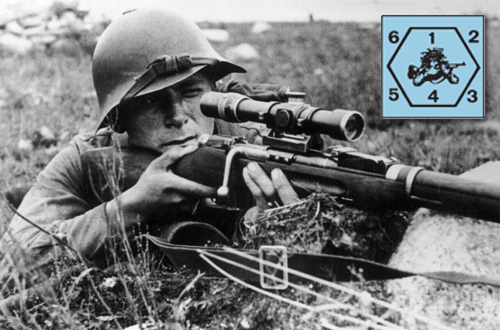
SNIPER ACTIVATION NUMBER (A14.1)
A number that represents the abstraction of snipers within the game. If the SAN is rolled there's a possibility of a random event caused by sniper activity. Snipers are a breed apart from the average soldier. Stealth and patience are every bit as important as marksmanship. They work alone, often in no man’s land or even behind enemy lines, and are subject to only one order: survival.
Slaughter at Ponyri (chapter SaP)
The savage fighting for Ponyri, dubbed A Timetable Disrupted, from 7 to 9 July 1943 during the Battle of Kursk. Its campaign runs six CG Dates, three days each split into an AM and PM CG Date, with a short Daytime Refit Phase standing in for the pause between them. Grenadier-Regiment 507 and 508, backed by Sturmgeschutz-Abteilung 244, pushed to seize the rail junction from dug-in Soviet defenders.

Scout Car
The vehicle type code in the Chapter H listings for a light, wheeled, usually open-topped reconnaissance vehicle. The American M3A1 is the pattern, and the British White Scout Car the same machine under another flag. Armies used them for liaison and for towing guns as often as for scouting, and the unarmed versions can't shoot back at all.
Specific Campaign Purchase Points (FB17.2)
The half of your Campaign Purchase Points reserved for hardware. SCPP buy only A-type and G-type Reinforcement Groups, meaning AFV and Guns, and they never convert back into the Generic pool. Leftover Generic points can top them up, so the armor you field in the next CG scenario is often decided by what you didn't spend on infantry.
SHAPE CHARGED WEAPON (C13.9)
A weapons the fires a specific ammo configuration, usually that of a rocket. These weapons include: Panzerfaust, Panzerschreck, Piat, Bazooka, etc. Fires HEAT ammo.
SMOKE DISPENSER (D13.1)
Refers to the collection of devices used by AFVs to dispense smoke during combat. They include: Smoke Dischargers (sD), Smoke Mortars (sM), Smoke Pots
(sP), and the Nahverteidigungswaffe (sN).
SIDE-MOUNTED FLAMETHROWER (D3.6)
Side-mounted (AFV) flamethrower.
Shore Fire-Control Party (G14.61)
The only onboard Observer a Naval OBA battery may use. A SFCP works solely with a U.S. or British NOBA battery and is always represented by a Chinese, Italian or Axis Minor 2-2-7 infantry-crew counter, owner's choice. It counts as the same nationality as its battery and otherwise has normal crew and Observer qualities.
SMOKE MORTAR (D13.1)
A type of AFV Smoke Dispenser. An AFV equipped with a Smoke Mortar can place smoke at a range of 1-3 hexes (in its TCA).
SINGLE MAN COUNTER (A1.1)
Represents a single individual (1 silhouette), an infantry leader or a hero.

SUBMACHINE GUN
An Infantry weapon inherently represented by a squad’s Assault Fire and Spraying Fire capabilities
SMOKE (A24)
The collective term for Smoke and White Phosphorus, written in capitals whenever a rule means both. A Good Order squad with a SMOKE Placement Exponent can try to lay it during its Movement Phase: one MF to place it in its own Location, two to put it in an ADJACENT one. The hex has to be named before the dr.
NAHVERTEIDIGUNGSWAFFE (A11.622/D13.34)
A German AFV Close Defense Weapon System capable of attacking same hex infantry or placing smoke.
Smoke Pots (D13.1)
Smoke Pots, one of the four vehicular smoke dispensers alongside Smoke Dischargers, Smoke Mortars and the Nahverteidigungswaffe. A vehicle carries them only if the reverse of its counter shows the abbreviation followed by a Usage Number, like sP7. That number is the abstracted chance the dispenser actually works when you call on it.
Self-Propelled
A weapon that drives itself rather than being towed. Take a gun designed for a carriage, bolt it onto a tank chassis, and you get a vehicle that can shoot and then leave. Most wear an open fighting compartment, so the crew counts as Crew Exposed whenever they're not buttoned up, and that's the trade for the mobility.
Self-Propelled Artillery
A field piece mounted on a chassis and driven to the fight. The British Deacon and the Russian SU-76 are typical: artillery calibers on tracks or wheels, meant to follow the advance rather than duel tanks. They can haul Riders, and Russian Guards Heavy SPA brigades mixed them with SU-100 tank destroyers by the dozen.
SPOTTING ROUND (C1.31)
Initial step of placing and correcting Off Board Artillery (OBA).

SPECIAL SCENARIO RULE
Any rule that's added to a scenario that goes above the normal ASL ruleset. Usually included at the bottom of the scenario sheet.
Slow Turret Traverse (D1.32)
A Main Armament type standing in for a two-man turret crew or a heavy, hand-cranked turret. You can spot it by the large thin white square on the counter, and the German Panther is the stock example. A related type, RST, goes further: those tanks can't use the MA or CMG while the commander is Crew Exposed.
Stream Overlay (B20.1)
The prefix on an overlay that lays a stream onto a board. A stream is a gully with a rivulet in it: a thin blue line on layered white, brown and dark green that runs right through two hexsides. That last part is the test. Where the stream symbol crosses only one hexside, or is a leftover remnant, the hex isn't a stream hex at all.
SUPPORT WEAPONS (A)
any weapon depicted on a 1/2" counter, such as MGs, flamethrowers, bazookas, demolition charges, light mortars, etc.
SCHUERZEN (D11.2)
Certain German AFV built or rebuilt after March 1943 had thin soft-steel plates called Schuerzen (aprons) attached at various points, the purpose of which was to prematurely detonate HEAT projectiles.

Towing Number (C10.1)
The Towing Number printed on a vehicle counter. It has to be at or under a Gun's Manhandling Number before that vehicle can tow it. Towing costs one extra MP per hex entered, added after every other modification, and no vehicle may tow a Gun over a wall or hedge or into a building or rubble.
TRAIL BREAK (B13.421)
Anytime a fully-tracked AFV enters a woods hex without benefit of Bypass or a road/TB hexside, a partial TB counter is placed on the hex.

TASK CHECK (A10.2)
An action required by a unit undergoing some task. A unit rolling less than or equal to it's morale level (including modifiers) passes the TC.
TURRET COVERED ARC (D3.12)
The TCA determines the Field of Fire of all turret-mounted weapons, and differs from the VCA only when a turret counter is placed on the vehicle with the Gun pointing toward a different hexspine than that of the vehicle counter. In the figure below the blue represents the TCA and the red represents the VCA.

Tank Destroyer
A vehicle built for one job: killing armor. The American M10 is the pattern, a Sherman chassis rearmed with a three inch gun, lightened with thinner sloped armor and topped with an open turret so the crew can see. Russia's SU-100 did the same with a naval gun. Fast, hard hitting, and horribly exposed to anything landing overhead.
Terrain Effect Modifier
The ability of a terrain feature to provide protection. Specified as a number that is usually added to a combat (or to hit) die roll.
To Hit # (C3.3)
The number required (when rolling 2 dice) to secure a hit on a target by Ordnance or any other weapon that uses the To Hit mechanics.
Temporarily Immobilized (A4.8)
A status Infantry picks up when it takes on a job that eats the whole Player Turn. The unit gets a TI counter, removed at the end of its own Close Combat Phase or the moment it breaks. While it's TI the unit can't move, advance, fire, or take on any other labor task that turn.
To Kill (C7.1)
What happens after you've hit a vehicle. The hit goes to a To Kill Table, one per ammunition type, and each lists a Basic TK# for every weapon that fires it. That number is the gun's penetration at 500 meters at a square impact angle, plus a base of 5. A Final TK# of 5 just barely gets through; 4 or less generally doesn't.
To Kill # (C7)
The number required (when rolling 2 dice) to affect some form of destruction on a vehicular target. A hit must be secured first!
Tripled Point Blank Fire (A7.21)
Point Blank Fire doubles a unit's Small Arms, MG, ATR or IFE firepower when it's adjacent to the target. Share the target's Location instead, or shoot at Passengers and Riders in your own hex, and that doubling becomes a tripling. Ordnance never gets it. A unit eligible for TPBF can only shoot at the enemy in its own Location.
Truck or Car (D1.15)
The counter shorthand for a soft-skinned wheeled vehicle. You can spot the class without reading a word: a Truck carries a white double circle behind its MP number, the figure eight standing in for two wheels, where an Armored Car gets a single circle and a fully tracked vehicle gets an oval. Russian GAZ-MM trucks are the stock example.
Tankette
A tiny interwar tracked vehicle, usually a two man machine gun carrier on a tractor chassis: the Italian L3, the Polish TKS, the British Carden-Loyd. They're armored fighting vehicles by the letter of the rules and they die like trucks in practice. ASL groups them with the Tank Destroyers and Carriers when it comes to hauling Riders around.
Underwater Demolition Teams (G14.22)
Navy frogmen sent in ahead of a landing to clear the way. In a Seaborne Assault the U.S. side may get UDT and use them to remove Beach Obstacles before the landing craft arrive. Anything they don't clear stays put, and tetrahedra are stubborn: once play starts only a Demolition Charge or a heavy HE attack shifts them.
Unconfirmed Kill (C7.4)
A hit that fails to penetrate armor can still wreck a vehicle from the inside. A non-MG, non-HE To Kill DR one over the Final To Kill Number puts the AFV at risk of Shock, and an HE turret hit brings it on automatically. Unconfirmed Kill is where that AFV and the men aboard end up if they can't shake the Shock off.
Unit Size Number (A1.6)
A unit's inherent size rating, standing in for bulk, number of men and ease of concealment. Personnel carry a number equal to the silhouettes on the counter: one for a single man, two for a crew or half-squad, three for a squad. Horses and other 5/8 inch counters rate four.
Vehicular Bypass Movement (D2.3)
The ability of a vehicle to move around building/woods in a hex instead of through the obstacle in that hex. VBM enables vehicles (and animal-drawn transport) to move through a building/woods hex at a reduced MP (MF) cost without risking Bog penalties for movement through those obstacles.
Victory Conditions (A26)
The goal(s) that (usually) one side must meet to win a scenario. If goals are not achieved, the other side wins the scenario.
VEHICLE COVERED ARC (D3.11)
The VCA represents the direction a vehicle's body (or hull) is pointing, and determines the Field of Fire of all bow/hull-mounted weapons, and differs from the TCA only when a turret counter is placed on the vehicle with the Gun pointing toward a different hexspine than that of the vehicle counter. In the figure below the blue represents the TCA and the red represents the VCA.
Valor of the Guards (chapter V)
The Stalingrad module that puts you on the Volga bank itself. Its map brings piers on the river, lumberyards, rail cars, fountains, city squares and gutted buildings, and it leans on the Red Barricades rules for the parts both modules share. Narrow Streets work differently here too, with the usual turret and hull facing restrictions lifted.
VICTORY POINTS (A26.2)
Each unit in ASL has a Victory Point number often used to determine scenario victory conditions. See A26.2
Glossary Link
Woods Overlay
The prefix on an overlay that drops woods onto a board. What it lays down is ordinary woods: dark green with black tree symbols, a one level LOS obstacle stacked on top of whatever the hex already is, so woods on a level one hill blocks as though it were level two. Pine woods and Forest are the exceptions, and both need a special rule.
White Die Roll (A.1)
The white die on its own. ASL rolls a white die and a colored die together and sums them for most purposes, but a good many rules want one of the two read separately. Where a rule asks for a wdr it means the white die alone, and where it asks for a cdr it means the colored one.
White Phosphorus (A24.3)
A nastier form of SMOKE, commonly available only to the U.S. player. British squads get WP grenades from 1944, as do elite Japanese squads and Chinese 5-3-7s; anybody else needs a scenario rule to allow it. Placement follows the ordinary smoke grenade rules, except you have to announce WP before the Placement DR.
Walking Wounded (Q CG17)
Lightly hurt men patched up and sent back, in the Pegasus Bridge and A Bridge Too Far campaigns. British Airborne MMC lost to Double Break, Casualty MC or Fate go into the WW box rather than out of the game, and each Refit Phase a squad equivalent in that box comes back as one MMC of the same type. A WW unit moves on three MF.
Breakdown Number (A9.7)
The unforgiving version of a Support Weapon's Breakdown Number. Every SW has an inherent B12 unless a B# or X# is printed on its counter. When the Original resolution DR reaches that number the weapon malfunctions, but where a B# weapon is merely inverted and can be repaired later, an X# weapon can't be repaired at all.
